Flour. Sugar. Sawdust. Harmless in a bowl — and explosive the second it's airborne.
That's not a hypothetical. In 2008, sugar dust leveled a refinery in Georgia and killed 14 people — and it's exactly the kind of risk that gets missed when standard equipment goes into a space that was never properly classified.
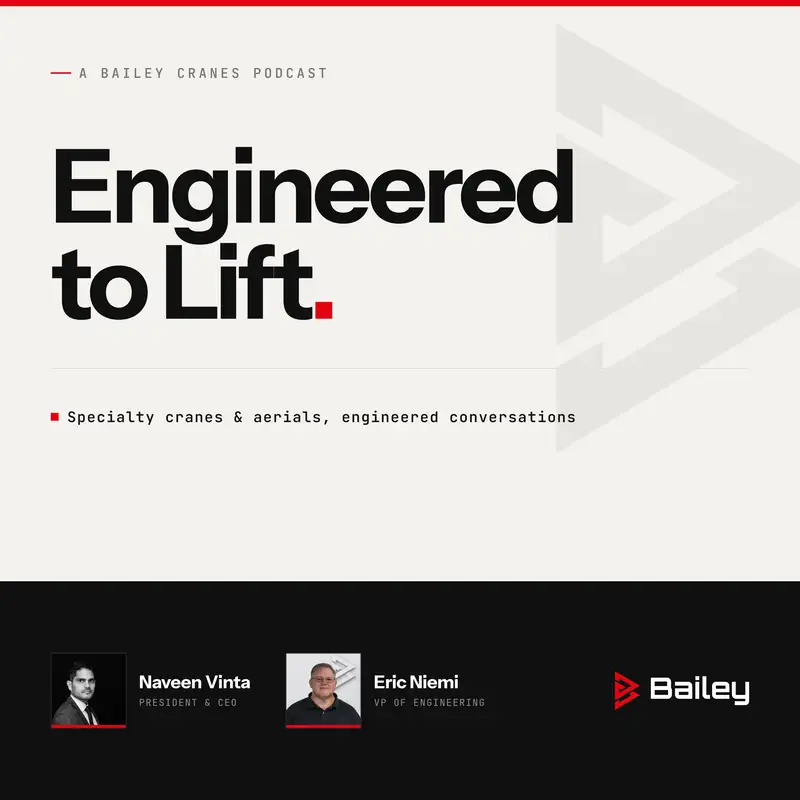
Welcome to Engineered to Lift — the podcast by Bailey Specialty Cranes & Aerials where we do the calculations, read the regulations, and tell you what actually matters when it comes to custom aerial work platforms, explosion-proof lifts, clean room man lifts, and specialty lifting equipment.
In Episode 2, President & CEO Naveen Vinta and VP of Engineering Eric Niemi break down how a hazardous environment actually gets classified — the Class, Division, and Group system — and why the environment, not the equipment, always comes first.
Who This Podcast Is For
This show exists for three people:
The procurement agent who's been handed a spec they've never sourced before and doesn't know where to start.
The production floor manager who needs to improve productivity and access in a complex or regulated environment — safely.
The finance and risk officer who signs off on equipment purchases and carries the liability when the wrong machine gets approved.
If any of those descriptions sound familiar, this is your show.
This show exists for three people:
The procurement agent who's been handed a spec they've never sourced before and doesn't know where to start.
The production floor manager who needs to improve productivity and access in a complex or regulated environment — safely.
The finance and risk officer who signs off on equipment purchases and carries the liability when the wrong machine gets approved.
If any of those descriptions sound familiar, this is your show.
What You'll Learn in This Episode
- Why everyday materials — flour, sugar, sawdust, even fabric fibers — turn into explosive fuel the moment they're airborne
- The three-part system that classifies every hazardous location in North America: Class (gas, dust, or fibers), Division (how often it's present), and Group (which fuel, and how volatile)
- Why temperature is the critical fourth factor — and how Factory Mutual's 8-hour continuous burn test proves a machine won't become an ignition source
- The real-world cost of getting it wrong: the 2008 Imperial Sugar dust explosion that killed 14 people
- Why every piece of equipment in a classified space — AC units, filters, forklifts, control cabinets, even digital displays — has to be rated, not just the lift
- The containment philosophy behind every Bailey machine: you don't stop the spark, you contain it
- How North America's Class/Division/Group system compares to Europe's ATEX zones and the worldwide IECEx standard
- Who actually classifies your site — the Authority Having Jurisdiction, usually your local fire marshal or a nationally recognized testing lab — and why you start there before buying anything
- A look ahead: how regulations translate between global zones, and next episode's deep dive into clean rooms
- Why everyday materials — flour, sugar, sawdust, even fabric fibers — turn into explosive fuel the moment they're airborne
- The three-part system that classifies every hazardous location in North America: Class (gas, dust, or fibers), Division (how often it's present), and Group (which fuel, and how volatile)
- Why temperature is the critical fourth factor — and how Factory Mutual's 8-hour continuous burn test proves a machine won't become an ignition source
- The real-world cost of getting it wrong: the 2008 Imperial Sugar dust explosion that killed 14 people
- Why every piece of equipment in a classified space — AC units, filters, forklifts, control cabinets, even digital displays — has to be rated, not just the lift
- The containment philosophy behind every Bailey machine: you don't stop the spark, you contain it
- How North America's Class/Division/Group system compares to Europe's ATEX zones and the worldwide IECEx standard
- Who actually classifies your site — the Authority Having Jurisdiction, usually your local fire marshal or a nationally recognized testing lab — and why you start there before buying anything
- A look ahead: how regulations translate between global zones, and next episode's deep dive into clean rooms
Episode Chapters
00:00 — The pizza-dough problem: why flour becomes fuel
01:00 — Why processing plants are at risk: the 2008 Imperial Sugar explosion
02:00 — Start with the environment, not the lift
03:00 — Welcome + the Class, Division & Group framework
04:00 — Class I vs Class II, Division 1 vs Division 2, and Groups A–G
05:00 — Classifying dusts (NFPA 70) and the fourth factor: temperature
06:00 — How heat ignites dust & the Factory Mutual 8-hour burn test
07:00 — Who needs this: aerospace, mining, oil & gas, and dust testing at Purdue
08:00 — Garment fibers, and the principle: contain the spark, don't stop it
09:00 — Every machine in the room has to be rated — not just the lift
10:00 — Beyond North America: Europe's ATEX & the worldwide IECEx
11:00 — People over equipment + a future guest on translating zones
12:00 — Authority Having Jurisdiction: start with your fire marshal
13:00 — One company, many sites, different jurisdictions
14:00 — Coming up: clean rooms — keeping particulate out
15:00 — Clean-room certification basics & wrap-up
00:00 — The pizza-dough problem: why flour becomes fuel
01:00 — Why processing plants are at risk: the 2008 Imperial Sugar explosion
02:00 — Start with the environment, not the lift
03:00 — Welcome + the Class, Division & Group framework
04:00 — Class I vs Class II, Division 1 vs Division 2, and Groups A–G
05:00 — Classifying dusts (NFPA 70) and the fourth factor: temperature
06:00 — How heat ignites dust & the Factory Mutual 8-hour burn test
07:00 — Who needs this: aerospace, mining, oil & gas, and dust testing at Purdue
08:00 — Garment fibers, and the principle: contain the spark, don't stop it
09:00 — Every machine in the room has to be rated — not just the lift
10:00 — Beyond North America: Europe's ATEX & the worldwide IECEx
11:00 — People over equipment + a future guest on translating zones
12:00 — Authority Having Jurisdiction: start with your fire marshal
13:00 — One company, many sites, different jurisdictions
14:00 — Coming up: clean rooms — keeping particulate out
15:00 — Clean-room certification basics & wrap-up
About Your Hosts
Naveen Vinta — President & CEO, Bailey Specialty Cranes & Aerials A Service-Disabled U.S. Army Veteran and experienced operations leader, Naveen acquired Bailey in August 2024 and has since modernized operations, reduced lead times, and expanded Bailey's reach into commercial space, defense, and data center markets. Connect with Naveen on LinkedIn: https://www.linkedin.com/in/nvinta/
Eric Niemi — VP of Engineering, Bailey Specialty Cranes & Aerials With over 25 years of experience in mechanical engineering and specialty mobile machinery, Eric has been with Bailey since the beginning — helping design and deliver the industry's first explosion-proof scissor lift in 2004. He leads Bailey's engineering team and is the technical authority behind every certified machine that leaves the Muskego, Wisconsin facility. Connect with Eric on LinkedIn: https://www.linkedin.com/in/eric-niemi-43a8103/
About Bailey Cranes
Bailey Specialty Cranes & Aerials is a U.S.-based manufacturer of explosion-proof aerial lifts, clean room man lifts, compact handlers, glass lifting equipment, and fully custom engineered lifting solutions. Headquartered in Muskego, Wisconsin, Bailey is ISO 9001:2015 certified, Factory Mutual approved, and a certified Service-Disabled Veteran-Owned Small Business (SDVOSB).
Bailey Specialty Cranes & Aerials is a U.S.-based manufacturer of explosion-proof aerial lifts, clean room man lifts, compact handlers, glass lifting equipment, and fully custom engineered lifting solutions. Headquartered in Muskego, Wisconsin, Bailey is ISO 9001:2015 certified, Factory Mutual approved, and a certified Service-Disabled Veteran-Owned Small Business (SDVOSB).
Bailey machines are engineered to ANSI A92.20, FM Class 3600/3610/3615, and UL 583 standards for use in Class I Division 1 hazardous locations, ISO Class 5–8 cleanrooms, aerospace facilities, defense installations, semiconductor manufacturing environments, and data centers.
Trusted clients include Boeing, NASA, Lockheed Martin, Northrop Grumman, Raytheon, the U.S. Air Force, Disney, and the Smithsonian Institution. Safety engineered. Performance delivered.
Trusted clients include Boeing, NASA, Lockheed Martin, Northrop Grumman, Raytheon, the U.S. Air Force, Disney, and the Smithsonian Institution. Safety engineered. Performance delivered.
Resources & Links
Bailey Cranes Website: https://baileycranes.com
Send us your questions: podcasts@baileycranes.com
Naveen Vinta on LinkedIn: https://www.linkedin.com/in/nvinta/
Eric Niemi on LinkedIn: https://www.linkedin.com/in/eric-niemi-43a8103/
New episodes drop every two weeks. Subscribe wherever you listen to podcasts.
Bailey Cranes Website: https://baileycranes.com
Send us your questions: podcasts@baileycranes.com
Naveen Vinta on LinkedIn: https://www.linkedin.com/in/nvinta/
Eric Niemi on LinkedIn: https://www.linkedin.com/in/eric-niemi-43a8103/
New episodes drop every two weeks. Subscribe wherever you listen to podcasts.