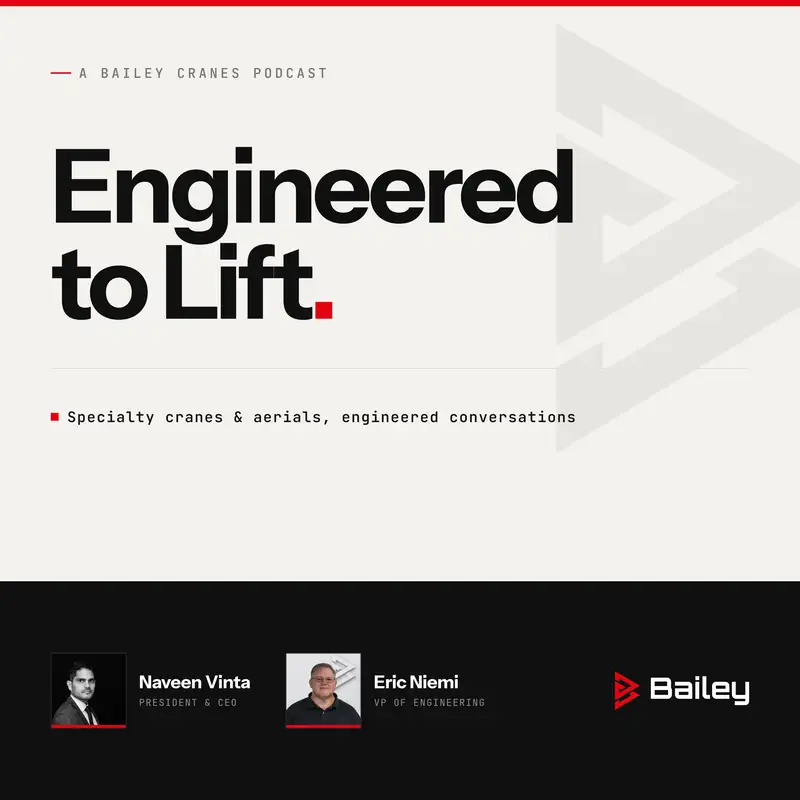
One of the biggest names in aerial lifts just decided the market wasn't worth staying in. Terex is merging with REV Group and moving to exit its aerials segment — Genie — to reduce its exposure to cyclical end markets. Bailey builds aerial work platforms too. The cyclicality doesn't bother us.
That isn't a contradiction, and this episode explains why.
President & CEO Naveen Vinta is joined by Timothy Cooley, Director of Sales, for a look at what actually happens between a customer's first phone call and the serial plate on a finished machine. Two custom compact handlers are on the floor right now: a CH1 with a magnetic attachment for a steel producer whose safety standard caps manual lifting at 50 pounds, and a CH6SP being re-rated to place 950 pounds at 14.5 feet for a canning plant that's been sending people over 20-foot drops to reach equipment. Along the way: why most customers arrive by accident through a Google search, why a purpose-built machine is sometimes the cheap option next to a $15 million dock replacement, how the feasibility study keeps a custom project from stalling in an approval chain, and why federal rated contracts can legally jump the queue.
Watch Now
Who This Episode Is For
- Production and facility managers with a lift problem no catalog machine solves — heavy load, narrow aisle, no overhead capacity
- Procurement teams sourcing a custom machine for the first time and unsure how the process is supposed to work
- Safety leaders trying to design manual handling and fall exposure out of a process rather than train around it
- Rental houses fielding customer requests for equipment they've never heard of
- Owners and operators at small manufacturers watching the large OEMs retreat from cyclical markets
What You'll Learn
- Why Terex's exit from aerials is a commodity-market story — and why the niche end of the same industry runs on a different cycle
- How most Bailey customers actually arrive: a Google search, a problem they can't name, and a call that opens with "do you have any idea what this is?"
- What a constrained lift looks like in practice — 40 feet of reach inside a five-foot-wide aisle, for an automaker's energy division
- Why custom is frequently the cheaper option: a steel producer weighing a purpose-built lift against a $15 million dock replacement
- Inside the CH1 build: a magnetic attachment engineered around a facility rule capping one-person lifts at 50 pounds and two-person lifts at 100
- Inside the CH6SP: what "special purpose" means, and what it takes to raise a base machine to 950 pounds at 14.5 feet with added counterweight
- Why every Bailey machine is tested to 150% of rated capacity before it ships
- How the feasibility study phase works — a concept report you can walk into your approval chain — and why some projects should end right there
- How Bailey's model naming works: the number after CH indicates capacity, and SP means special purpose
- Why the first custom unit carries the engineering and units two through eight get the economies of scale
- The real sales cycle: inquiries in January and February become purchase orders in September and October, six to twelve months later
- Why federal rated contracts can legally move ahead of an order already in build — and what that means for your delivery date
Episode Chapters
00:00 — A Major Aerials Player Exits, and Bailey Doesn't Flinch
01:00 — Meet Tim Cooley: Seven Years in Ranger Regiment to Director of Sales
02:00 — The Trade Show Booth, the Coffee Chews, and a Very Good Day
03:00 — No Résumé, No Interview: Hire for Attitude, Teach Aptitude
04:00 — Terex's Numbers: $537M in Q3, Down 13%, and "Cyclical End Markets"
05:00 — Q4 Rebounds, JLG's Backlog, Skyjack's Booms — Aerials Aren't Dying
06:00 — How Customers Actually Find Us: A Google Search and a Long Shot
07:00 — "I've Been Looking for Months": The Constraints Nobody Else Solves
08:00 — Forty Feet of Reach Inside a Five-Foot Aisle
09:00 — When a Custom Machine Beats a $15 Million Dock Replacement
10:00 — The CH1 Build: A Magnetic Attachment and a 50-Pound Lifting Limit
11:00 — Design Review Before Build: The White-Glove Approach
12:00 — The Feasibility Study: Concept First, Full Project Second
13:00 — Phased Approvals, and Why Some Projects Should End at Concept
14:00 — The CH6SP: A Canning Plant's Reach and Fall-Hazard Problem
15:00 — Re-Rating a Base Machine: 950 Pounds at 14.5 Feet
16:00 — Testing to 150%, and One Unit That Becomes Six or Eight
17:00 — Economies of Scale: You're Not Starting From Scratch
18:00 — Real Cyclicality: July Is Slow, and Even Apple Feels It
19:00 — September and October: The Federal Fiscal Year Rush
20:00 — Engineered Access and Lifting: Bring Us the Problem
21:00 — January Inquiry, September PO: Six Months to a Year
22:00 — Why Every Quote Carries an "As Of" Date
23:00 — Rated Contracts, the Queue, and What's Coming Up With Tim
01:00 — Meet Tim Cooley: Seven Years in Ranger Regiment to Director of Sales
02:00 — The Trade Show Booth, the Coffee Chews, and a Very Good Day
03:00 — No Résumé, No Interview: Hire for Attitude, Teach Aptitude
04:00 — Terex's Numbers: $537M in Q3, Down 13%, and "Cyclical End Markets"
05:00 — Q4 Rebounds, JLG's Backlog, Skyjack's Booms — Aerials Aren't Dying
06:00 — How Customers Actually Find Us: A Google Search and a Long Shot
07:00 — "I've Been Looking for Months": The Constraints Nobody Else Solves
08:00 — Forty Feet of Reach Inside a Five-Foot Aisle
09:00 — When a Custom Machine Beats a $15 Million Dock Replacement
10:00 — The CH1 Build: A Magnetic Attachment and a 50-Pound Lifting Limit
11:00 — Design Review Before Build: The White-Glove Approach
12:00 — The Feasibility Study: Concept First, Full Project Second
13:00 — Phased Approvals, and Why Some Projects Should End at Concept
14:00 — The CH6SP: A Canning Plant's Reach and Fall-Hazard Problem
15:00 — Re-Rating a Base Machine: 950 Pounds at 14.5 Feet
16:00 — Testing to 150%, and One Unit That Becomes Six or Eight
17:00 — Economies of Scale: You're Not Starting From Scratch
18:00 — Real Cyclicality: July Is Slow, and Even Apple Feels It
19:00 — September and October: The Federal Fiscal Year Rush
20:00 — Engineered Access and Lifting: Bring Us the Problem
21:00 — January Inquiry, September PO: Six Months to a Year
22:00 — Why Every Quote Carries an "As Of" Date
23:00 — Rated Contracts, the Queue, and What's Coming Up With Tim
Your Hosts
Naveen Vinta — President & CEO, Bailey Specialty Cranes & Aerials
Timothy Cooley — Director of Sales, Bailey Specialty Cranes & Aerials
About Bailey
Bailey Specialty Cranes & Aerials designs and manufactures custom aerial work platforms for hazardous, classified, and mission-critical environments — explosion-proof lifts, clean room man lifts, compact handlers, and specialty MEWPs. ISO 9001:2015 certified and Factory Mutual approved, Bailey serves aerospace, defense, pharmaceutical, semiconductor, and industrial clients including Boeing, NASA, Lockheed Martin, Northrop Grumman, Raytheon, and the U.S. Air Force. Safety engineered. Performance delivered.
Connect
New episodes every two weeks — subscribe wherever you listen.
Web: baileycranes.com
Email: podcasts@baileycranes.com
YouTube: @baileycranes
Naveen Vinta: https://www.linkedin.com/in/nvinta/
Timothy Cooley: https://www.linkedin.com/in/timothy-cooley-931844310/
Email: podcasts@baileycranes.com
YouTube: @baileycranes
Naveen Vinta: https://www.linkedin.com/in/nvinta/
Timothy Cooley: https://www.linkedin.com/in/timothy-cooley-931844310/