In Memphis, one of the best-capitalized operations in the country trucked in a fleet of trailer-mounted gas turbines — roughly 1,500 megawatts of temporary power — and rented them. Not because they couldn't afford the real thing. Because they couldn't get in line for it.
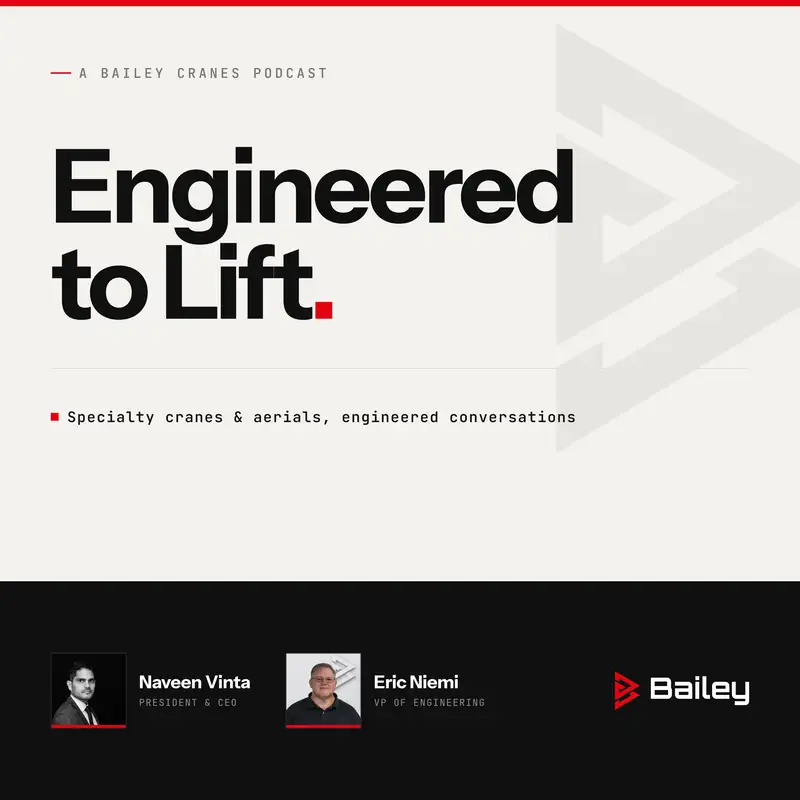
That's the whole story of the AI build-out in one image. The headlines are political. Underneath the politics, it's physical. In this episode, President & CEO Naveen Vinta and VP of Engineering Eric Niemi make the case that the AI race has quietly become a manufacturing race — where money is no longer the constraint, the queue is. Pick any critical component and it's backordered past your finish line. A bigger check doesn't move you up the line; it only gets you in it. Along the way: why stopping technology has never been a winning proposition, what happens when you go looking for a wheel drive whose manufacturer has been sold twice in ten years, the backyard paradox of Wisconsin hosting a manufacturing-scale build-out after losing manufacturing as its top employer, and how a niche manufacturer splits a part in two to build a supply chain that didn't exist yesterday.
Watch Now
Who This Episode Is For
- Procurement agents staring at a 26-week lead time on a component the schedule needed last quarter
- Data center developers, GCs, and project managers whose critical path now runs through a factory floor
- Engineering and operations leaders deciding whether to wait for the catalog part or redesign around what's actually available
- Niche manufacturers and component suppliers who make hard-to-find parts and are hard to find themselves
- Anyone watching the AI build-out and wondering where the real bottleneck sits
What You'll Learn
- Why money stopped being the constraint on the AI build-out — and why a place in the queue is all a check can buy you
- What renting 1,500 megawatts of trailer-mounted turbines tells you about the state of industrial lead times
- Why efforts to stop a technology have historically only slowed it down, from 1920s battery trucks to the electric Hummer
- How a discontinued wheel drive turns into an engineering project: changed bolt patterns, changed capacities, changed speeds
- The backyard paradox — Wisconsin lost manufacturing as its top employer and is now hosting the largest industrial construction in state history
- Why skilled labor is the second queue nobody talks about, and how the right machine lets five technicians do a ten-technician job safely
- The adaptation play: splitting a single drive unit into a hub and a hydraulic motor, sourcing each separately, and doubling your supply chain in the process
- Why a 30-week finished assembly can often be beaten by four-to-six-week components and skilled hands in-house
- How AI is clearing rote work off engineers' desks so they can spend the time on what the customer actually needs
- Why a manufacturing race is won by the whole bench — giants, niche manufacturers, and small shops together
Episode Chapters
Your Hosts
Naveen Vinta — President & CEO, Bailey Specialty Cranes & Aerials
Eric Niemi — VP of Engineering, Bailey Specialty Cranes & Aerials
Naveen Vinta — President & CEO, Bailey Specialty Cranes & Aerials
Eric Niemi — VP of Engineering, Bailey Specialty Cranes & Aerials
About Bailey
Bailey Specialty Cranes & Aerials designs and manufactures custom aerial work platforms for hazardous, classified, and mission-critical environments — explosion-proof lifts, clean room man lifts, compact handlers, and specialty MEWPs. ISO 9001:2015 certified and Factory Mutual approved, Bailey serves aerospace, defense, pharmaceutical, semiconductor, and industrial clients including Boeing, NASA, Lockheed Martin, Northrop Grumman, Raytheon, and the U.S. Air Force. Safety engineered. Performance delivered.
Connect
New episodes every two weeks — subscribe wherever you listen.
Web: baileycranes.com
Email: podcasts@baileycranes.com
YouTube: @baileycranes
Naveen Vinta: https://www.linkedin.com/in/nvinta/
Eric Niemi: https://www.linkedin.com/in/eric-niemi-43a8103/
Email: podcasts@baileycranes.com
YouTube: @baileycranes
Naveen Vinta: https://www.linkedin.com/in/nvinta/
Eric Niemi: https://www.linkedin.com/in/eric-niemi-43a8103/