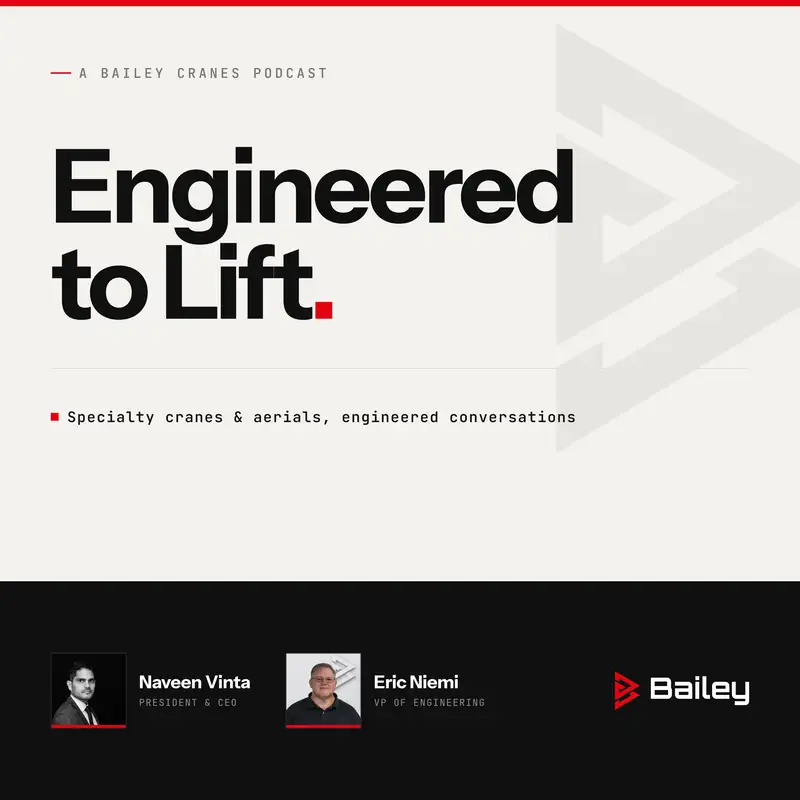
In 1869 two crews met in Utah and drove a golden spike, and a farmer on the plains could sell to New York. In 1956 Eisenhower signed the interstate bill, and a trucker out of Wisconsin could reach anywhere. Neither project handed anybody a living — it handed everybody a road. The data centers going up across the country right now are that kind of project, and the people who gain the most won't be the ones who lay the track. They'll be the ones who ride it.
Bailey is a niche manufacturer in Muskego, Wisconsin. No software department, never much marketing material. Today the shop runs software it wrote itself — SOLIDWORKS macros that get written, used once, and thrown away; a geo-located time clock that feeds payroll automatically; Blender renders that turn STEP files into supercar-grade catalogs — all on tools that ride on those data centers. President & CEO Naveen Vinta and VP of Engineering Eric Niemi walk through exactly what that looks like on the floor, what it costs, what it replaced, and why a company built on engineering can no longer let marketing take a back seat.
Watch Now
Who This Episode Is For
- Owners of small and mid-size manufacturers who can't justify a full-time developer but keep losing engineering hours to repetitive work
- Engineering managers running engineer-to-order shops where no two jobs — and no two macros — are the same
- Operations and purchasing leads waiting weeks on quotes for one-off parts
- Anyone whose company does excellent work but has little to show for it, because marketing never penciled out
- Small business owners who want to bring AI in thoughtfully and need a place to start
What You'll Learn
- Why the railroad and the interstate are the right lens for today's data center build-out — and why riding the infrastructure beats laying it
- Why a company that excels at engineering, calculations, and ANSI testing never built marketing material, and why "do the work and they will come" no longer holds when attention is the economy
- The safety case for marketing: somewhere a customer can't find the right machine and is doing the job dangerously instead
- What a SOLIDWORKS macro actually does — one button replacing 20 to 40 clicks — and why a human-written macro never had the ROI in an engineer-to-order shop
- How AI makes macros expendable like bullets: write one, use it once, discard it, and skip the maintenance burden every software update used to create
- Why an engineer checking and blessing the output is reinforcement learning with human feedback, in practice
- What SendCutSend gets right about instant quoting, why low-volume buyers rarely get treated as cream of the crop, and what removing the human from the loop costs
- Exporting STEP files into Blender via MCP to produce catalog imagery that used to be reserved for Ferrari or McLaren
- The full stack behind Bailey's time clock app — Supabase, Railway, GitHub, and a CI/CD loop where Claude writes the code and it auto-deploys — and how payroll now flows straight into the PEO
- The honest ROI: a roughly $400–500 monthly subscription returning four to five times its cost
- Using AI to digest 200-page standards and bring newer engineers up to speed, without replacing the judgment of the person reading the output
- Why AI removes drudgery rather than jobs — the radiology example, the Jevons paradox, and what the tractor was to a farmer who plowed by horse
- What's next in-house: a custom MCP connecting Claude to Outlook and NetSuite with per-user permissions
- Post-IMTS demos: Octonomy for engineering documentation and task control, Mech Agents for simulation, and where SOLIDWORKS' own native AI tools stand today
- Naveen's operating philosophy — relax the people, push the machines — and why a $5–10K desktop with 128 GB of RAM is now a supercomputer
Episode Chapters
- 00:00 — The Golden Spike, the Interstate, and the Data Center
- 01:00 — Ride the Rails: A Niche Manufacturer Writes Its Own Software
- 02:00 — Why Great Engineering Never Had Marketing to Match
- 03:00 — Attention Is the New Economy — and Marketing Is a Safety Issue
- 04:00 — Macros: Why a Human-Written Script Never Paid Off
- 05:00 — Expendable Macros: Write It, Use It, Discard It
- 06:00 — One Button, 40 Clicks: Taking the Drudgery Out of SOLIDWORKS
- 07:00 — SendCutSend and the Instant Quote
- 08:00 — Low Volume, Long Waits: The One-Off Parts Problem
- 09:00 — Speed by Taking the Human Out of the Loop
- 10:00 — STEP Files to Blender: Supercar-Grade Catalogs
- 11:00 — From Punch Cards to a Geo-Located Time Clock App
- 12:00 — Payroll on Autopilot, and the ROI on a Claude Subscription
- 13:00 — Reading a 200-Page Standard Without the Drudgery
- 14:00 — AI Takes the Drudgery, Not the Jobs
- 15:00 — Radiologists and the Jevons Paradox
- 16:00 — Horses, Tractors, and a Machine That Doesn't Sleep
- 17:00 — Building an MCP for Outlook and NetSuite, and a Free Consultation Offer
- 18:00 — Octonomy: Documenting the Whole Engineering Trail
- 19:00 — Reuse in Six Months, and FUD vs. FOMO
- 20:00 — Where SOLIDWORKS' Native AI Stands Today
- 21:00 — Relax the People, Push the Machines
- 22:00 — A $5–10K Supercomputer on a Desk
- 23:00 — Why a Manufacturing Podcast Talks About AI
Your Hosts
Naveen Vinta — President & CEO, Bailey Specialty Cranes & Aerials
Naveen comes from an IT background and leads Bailey's in-house AI and software efforts alongside running the company. He's offering a free consultation to small business owners who want a thoughtful path to bringing AI into their operations — reach out at podcasts@baileycranes.com.
Connect with Naveen on LinkedIn: https://www.linkedin.com/in/nvinta/
Naveen comes from an IT background and leads Bailey's in-house AI and software efforts alongside running the company. He's offering a free consultation to small business owners who want a thoughtful path to bringing AI into their operations — reach out at podcasts@baileycranes.com.
Connect with Naveen on LinkedIn: https://www.linkedin.com/in/nvinta/
Eric Niemi — VP of Engineering, Bailey Specialty Cranes & Aerials
With over 25 years of experience in mechanical engineering and specialty mobile machinery, Eric has been with Bailey since the beginning — helping design and deliver the industry's first explosion-proof scissor lift in 2004. He leads Bailey's engineering team and is the technical authority behind every certified machine that leaves the Muskego, Wisconsin facility.
Connect with Eric on LinkedIn: https://www.linkedin.com/in/eric-niemi-43a8103/
Mentioned in This Episode
- Bailey's Blender-rendered product catalog: [LINK — TO ADD]
- SendCutSend — instant quoting for one-off parts
- Octonomy — engineering documentation and task control
- Mech Agents — AI simulation tools
- Supabase, Railway, GitHub, and Claude — the stack behind Bailey's time clock app
About Bailey
Bailey Specialty Cranes & Aerials is a U.S.-based manufacturer of explosion-proof aerial lifts, clean room man lifts, compact handlers, glass lifting equipment, and fully custom engineered lifting solutions. Headquartered in Muskego, Wisconsin, Bailey is ISO 9001:2015 certified, Factory Mutual approved, and a certified Service-Disabled Veteran-Owned Small Business (SDVOSB).
Bailey machines are engineered to ANSI A92.20, FM Class 3600/3610/3615, and UL 583 standards for use in Class I Division 1 hazardous locations, ISO Class 5–8 cleanrooms, aerospace facilities, defense installations, semiconductor manufacturing environments, and data centers.
Trusted clients include Boeing, NASA, Lockheed Martin, Northrop Grumman, Raytheon, the U.S. Air Force, Disney, and the Smithsonian Institution. Safety engineered. Performance delivered.
Connect
New episodes every two weeks — subscribe wherever you listen. If you're using an AI tool with real ROI that we haven't come across, send it our way and we'll evaluate it.
Web: baileycranes.com
Email: podcasts@baileycranes.com
YouTube: @baileycranes
Naveen Vinta: https://www.linkedin.com/in/nvinta/
Eric Niemi: https://www.linkedin.com/in/eric-niemi-43a8103/
Email: podcasts@baileycranes.com
YouTube: @baileycranes
Naveen Vinta: https://www.linkedin.com/in/nvinta/
Eric Niemi: https://www.linkedin.com/in/eric-niemi-43a8103/